Ask
Start with a natural question.
 LuCre8z
Creative Technology · AI Product Development · Digital Operations
Managed AI Retrieval Assistant
AI Project Concierge + Smart Operations Agent
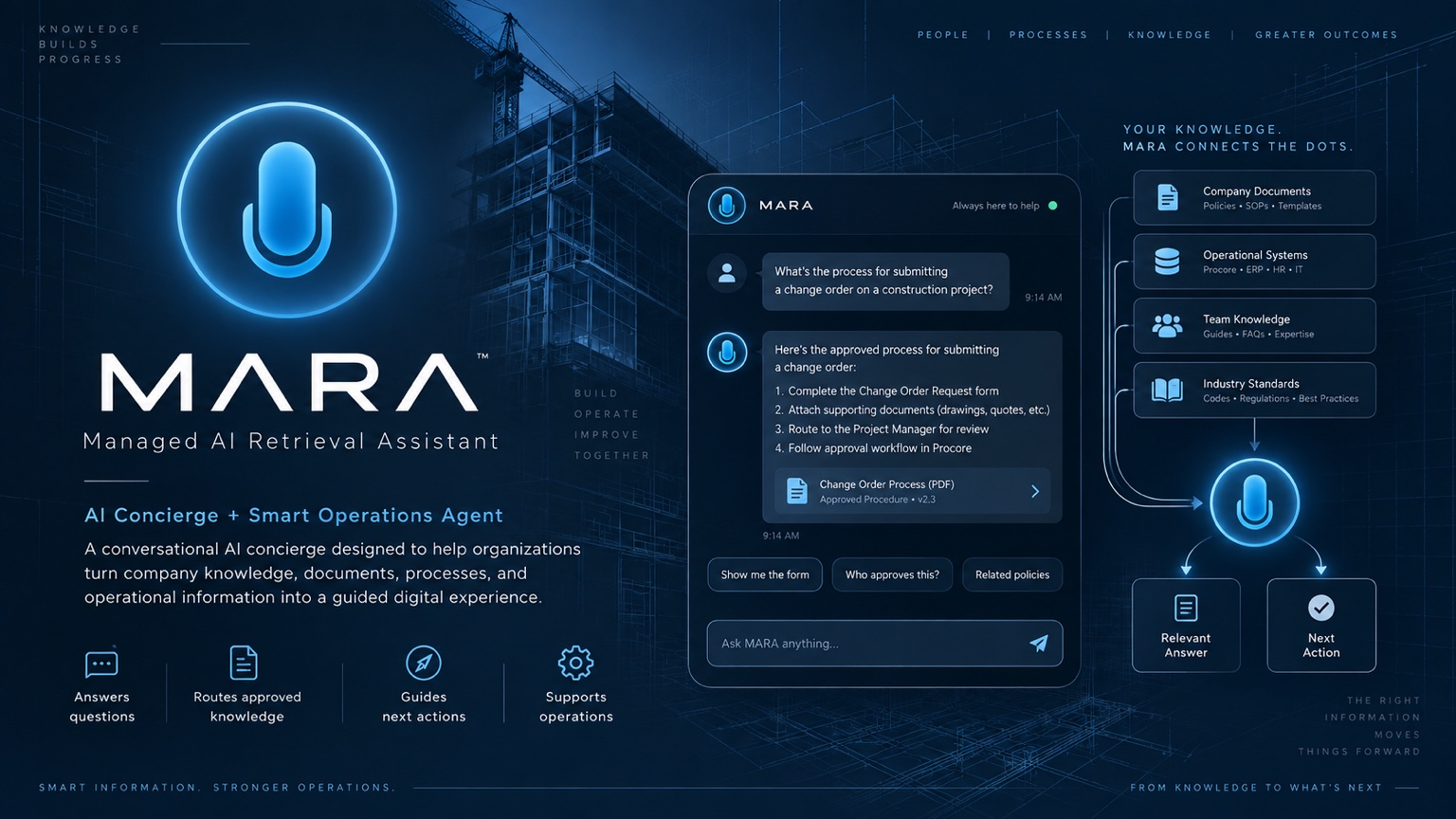
MARA is a conceptual AI product developed by LuCre8z to demonstrate how conversational AI can become a digital front door to organizational knowledge and business operations.
Case Study / Makiya Lesley · LuCre8z
LuCre8z developed the product concept, information structure, interface and front-end experience demonstration. The organizational setting is fictional. Knowledge retrieval and business-system connectivity are proposed capabilities, not functioning integrations in the current demo.
The concept
Rather than requiring users to search through multiple webpages, documents, policies, procedures, portals, and resources, MARA is designed to help people ask questions naturally, retrieve relevant information, and move toward the appropriate next action.
The prototype is presented through a fictional construction and infrastructure company to demonstrate how an AI concierge could support clients, vendors, subcontractors, and project stakeholders.
The challenge
Organizations often have important information spread across websites, documents, policies, project systems, spreadsheets, internal resources, and multiple departments.
Finding one answer can require navigating several pages, contacting staff, or searching through documentation.
MARA explores a different experience:
Start with a natural question.
Locate relevant approved knowledge.
Present information in a clear conversational context.
Move toward the appropriate next step.
Key decision
The experience
MARA is designed as a digital operations specialist rather than a generic chatbot.
Users can interact conversationally with the assistant to navigate project information, company services, safety and compliance, vendor requirements, project documentation, and policies and procedures.
The prototype illustrates how approved organizational information could be presented through a branded conversational interface. Live retrieval remains part of the proposed technical architecture.
Current vs. planned
The current Framer prototype proves the front-end product direction. It is a working demonstration of how people could navigate and experience MARA—not a finished, production-connected AI system.
Key decision
Role + product direction
Key decision
Status
The current Framer demo is proof of MARA’s front-end experience: its navigation, branded interface, conversational flow, information categories and intended path from a question toward a relevant answer or next action.
It does not represent a finished production deployment. Live knowledge retrieval, source citations, secure data connections, business-system integrations, workflow automation, agentic actions and other backend capabilities remain part of future development.
Process + product artifacts
This proposed UX specification makes the product direction reviewable. It is a design artifact, not evidence of a connected retrieval system or completed user research.
A subcontractor needs onboarding requirements but does not know which document or department owns them. The product goal is a clear route to approved information and the right contact.
The proposed entry points group questions into project information, policies, safety, vendor requirements and documents. Each production answer would need an accountable source and an appropriate access level.
Ask a question → clarify the project or role → show an approved source and answer → offer the next action. When a source is missing or access is restricted, explain the limit and route to a human contact.
For production: document owner, version, review date, permissions and source link. Permissions must be enforced before retrieval, and outdated or conflicting information must be flagged.
Makiya developed the product premise, information categories, interface direction and front-end prototype. The deliverables include the experience demonstration, conversation concept and proposed technical roadmap.
Test realistic tasks with representative project stakeholders. Observe task completion, time to find information, wrong turns, recovery and source comprehension. Production evaluation must separately test accuracy, permissions and escalation.
Continue exploring